


This publication presents the principles and validation of the Compatible Stress Field Method (CSFM).
This new method can be used for the design and assessment of any concrete structure subjected to in-plane loading and is particularly suited for the dimensioning of “discontinuity regions” such as corbels, deep beams, walls with openings, dapped beam-ends, and frame corners. The CSFM represents a significant step forward for structural engineering practice, as it allows the efficient checking of all design code provisions, including serviceability, load-deformation and deformation capacity aspects even for concrete members with complex geometry. The method is based on Finite Element Analysis and uses only basic material parameters employed in standard structural concrete design.
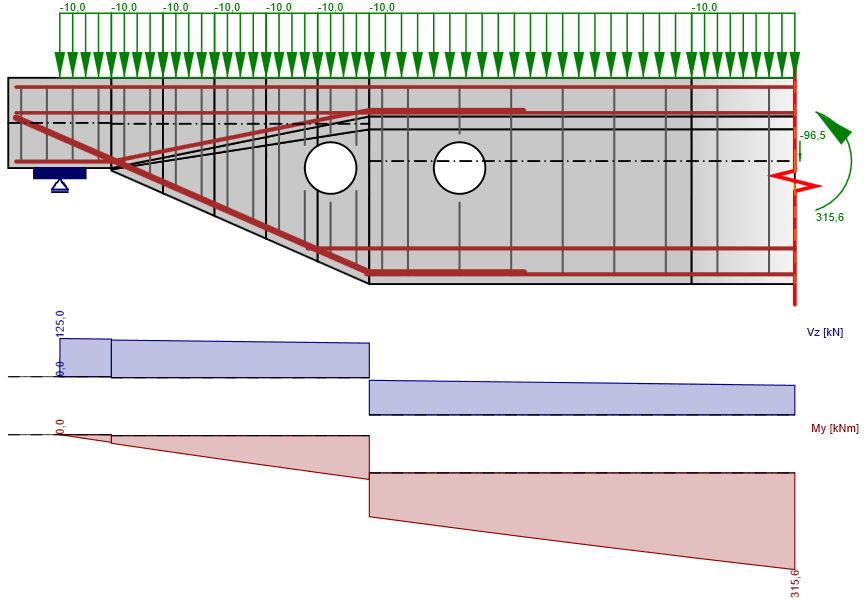
The results of the CSFM for a set of verification examples are presented and discussed, during which the influence of the main parameters of the method and its underlying models are also covered. The results are compared to a wide range of analytical solutions, design code provisions and experimental results, and show good agreement with all of them.
Listen to the author speaking about the CSFM method
Team of authors
Prof. Dr. Walter Kaufmann, Dr. Jaime Mata-Falcón, Dr. Marius Weber, Tena Galkovski, Duc Thong Tran, Dr. Jaromir Kabelac, Michael Konecny, Ass. Prof. Dr. Jaroslav Navratil, Michal Cihal, Petra Komarkova

ETH Zurich, Institute of Structural Engineering
About Prof. Dr. Walter Kaufmann
Walter Kaufmann is the Chair of Structural Engineering (Concrete Structures and Bridge Design) at ETH Zurich. He is the Chairman of the Swiss Concrete Code Commission and is a Lead Principal Investigator at the Swiss National Centre of Competence in Research (NCCR) in Digital Fabrication. His research focuses on innovative structures, the load-bearing and deformation capacity of concrete structures, the assessment of the structural safety of existing structures, and digital fabrication methods.

He obtained his degrees from ETH Zurich in 1992 (dipl. Bau-Ing.) and 1998 (Dr. sc. techn.). Prior to joining ETH Zurich in 2014, he was active in the industry for more than 15 years, working mainly in Spain and Switzerland. During this time, he directed numerous structural engineering projects for buildings and bridges, participated successfully in many bridge design competitions, and was involved in a large number of expert appraisals.
Citation
KAUFMANN, Walter, et al.
Compatible stress field design of structural concrete
ETH Zurich, 2020
ISBN 978-3-906916-95-8 print
158 pages
Buy ebook online
Buy the ebook (PDF) version online on Payhip.
Price: 60 EUR + VAT
Student: 18 EUR + VAT (contact us for a 70% discount voucher)
Content of the book
Here you can see the Table of contents demonstrating the range of tested examples. All results show a very close correlation with the compared data.