

Nonlinear analysis in Detail can finish in three different ways:
- Converged to the end (100% of the defined load applied)
- Stopped due to a stop criterion (a limit was reached and the solver terminated early)
- Stopped due to divergence (solver could not converge)
The general principles of reading results are described in the Results articles, see the dedicated part of the Support Center.
Stop criteria
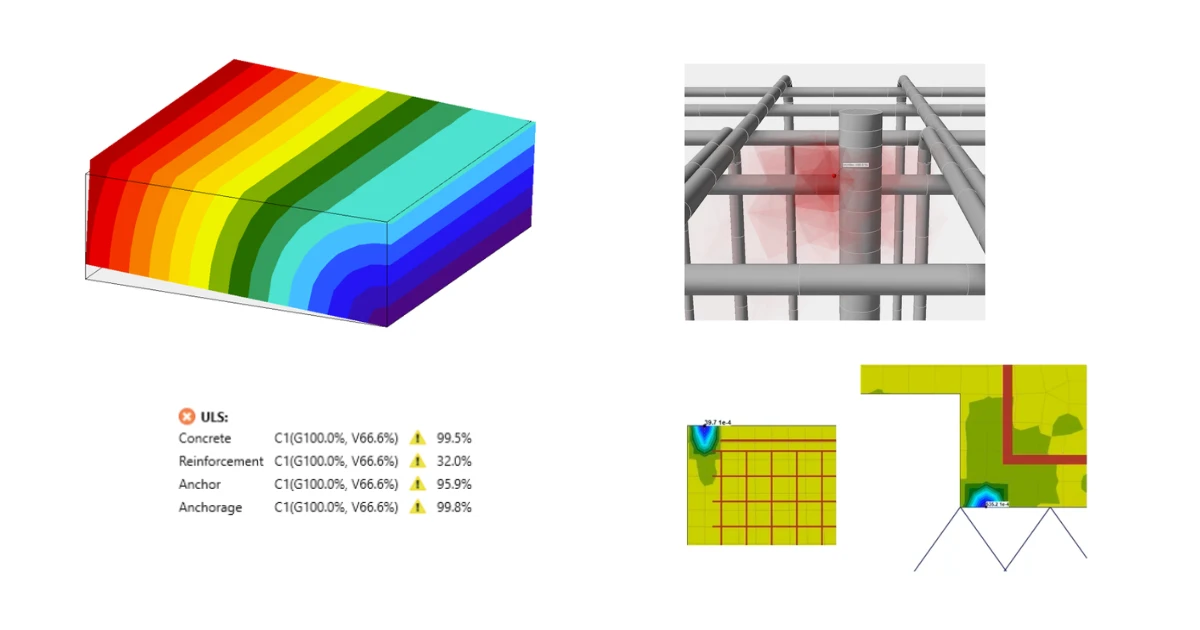
The solver terminated early because a material limit was exceeded, either in steel or concrete. To identify the exact cause, check the warnings displayed by the program after the calculation. Clicking "Failing Elements" will display the specific problem visually in the graphics window.
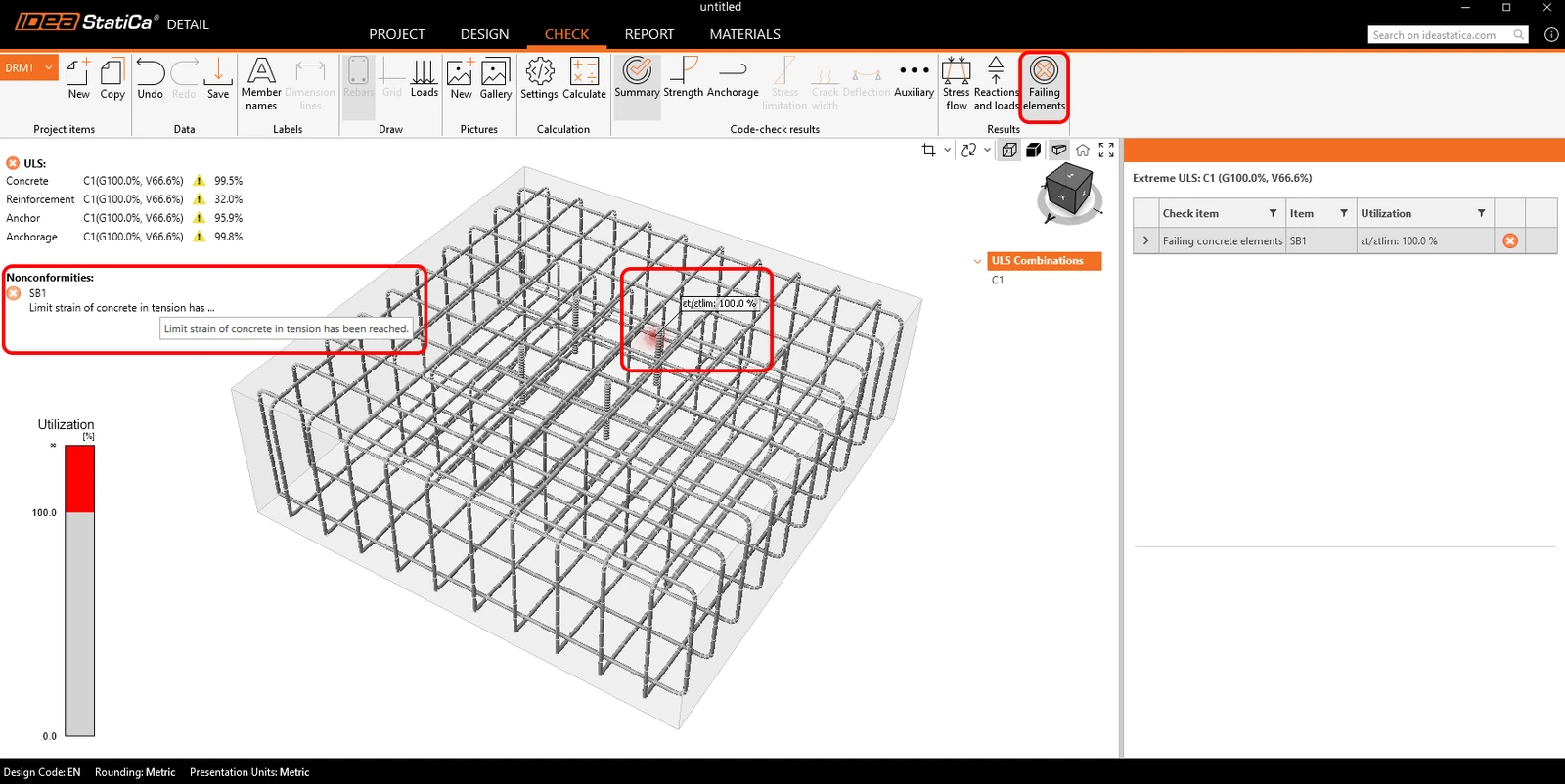
These warnings indicate which parameter exceeded the allowable limit and where to look in the model. The reason for exceeding the model limits may simply be that the load-bearing capacity has been exceeded, in which case, the design needs to be adjusted. Alternatively, it may be due to a modeling error or a violation of detailing rules, requiring closer examination. The most common warnings are listed below.
Detail 3D (3D CSFM solid model)
- The limit strain of concrete in tension has been reached.
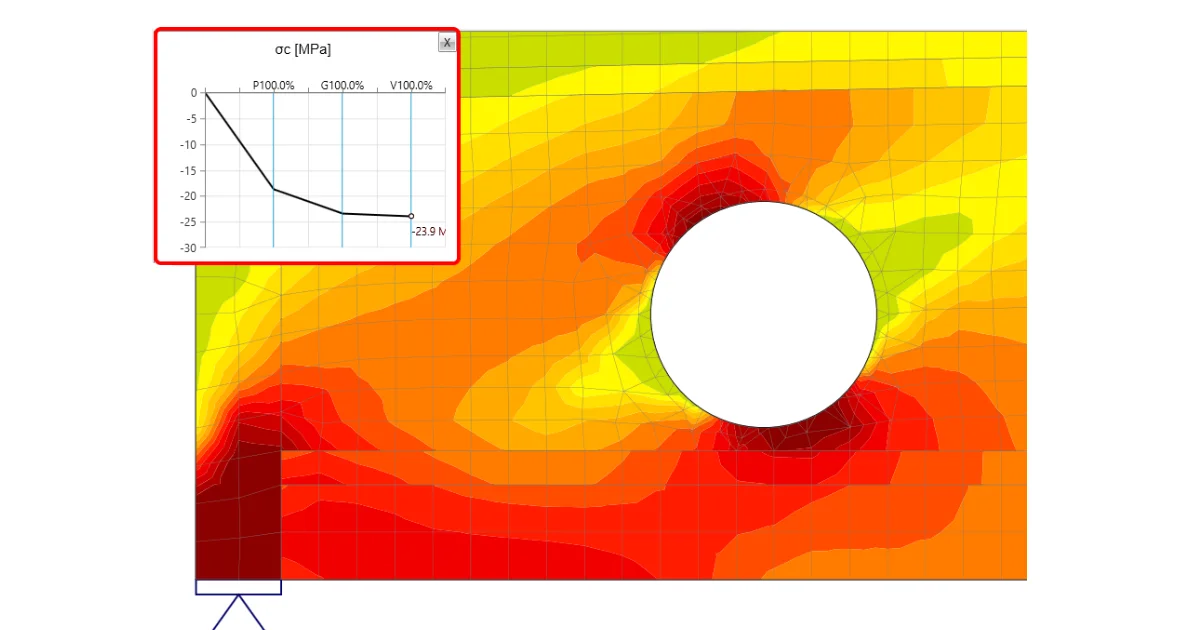
- The limit strain of concrete in compression has been reached.
- The limit strain of reinforcement in tension has been reached.
- The limit strain of reinforcement in compression has been reached.
- The limit strain of the anchor in tension has been reached.
- The slip between reinforcement and concrete has reached the limit value.
- The slip between anchor and concrete has reached the limit value.
- Concrete crushing at the anchor–concrete interface due to shear has reached the limit.
- The pull-out resistance of the anchor has been reached.
- The base plate deformation exceeds the allowable limit.
Stop criteria for nonlinear analysis:
- Maximum strain in concrete:
- 5% ultimate strain in compression
- 7% ultimate strain in tension
- Maximum strain in reinforcement:
- 5% ultimate strain (for reinforcing bars)
- xx% strain (for anchors other than reinforcing bars, dependent on strength class)
- Maximum slip in the bond element / maximum slip in end-anchorage elements:
- α·δu_max, where δu_max is the maximal slip used in code checks and α = 10.
- For anchoring – concrete edge/pryout failure under shear load
- per EN 1994-1-1, Eq. 6.19
- For anchoring – anchor pull-out under tension load (only for headed anchors)
- per EN 1992-4, Eq. 7.11
Detail 2D (CSFM shell model)
- The limit strain of concrete in tension has been reached.
- The limit strain of concrete in compression has been reached.
- The limit strain of reinforcement in tension has been reached.
- The limit strain of reinforcement in compression has been reached.
- The limit strain of prestressing reinforcement has been reached.
- The slip between reinforcement and concrete has reached the limit value.
Stop criteria for nonlinear analysis:
- Maximum strain in concrete:
- 5% ultimate strain in compression
- 7% ultimate strain in tension
- Maximum strain in reinforcement:
- 5% ultimate strain (for reinforcing bars)
- Maximum slip in the bond element / maximum slip in end-anchorage elements:
- α·δu_max, where δu_max is the maximal slip used in code checks and α = 10.
More details can be found in Theoretical Background.
Divergence
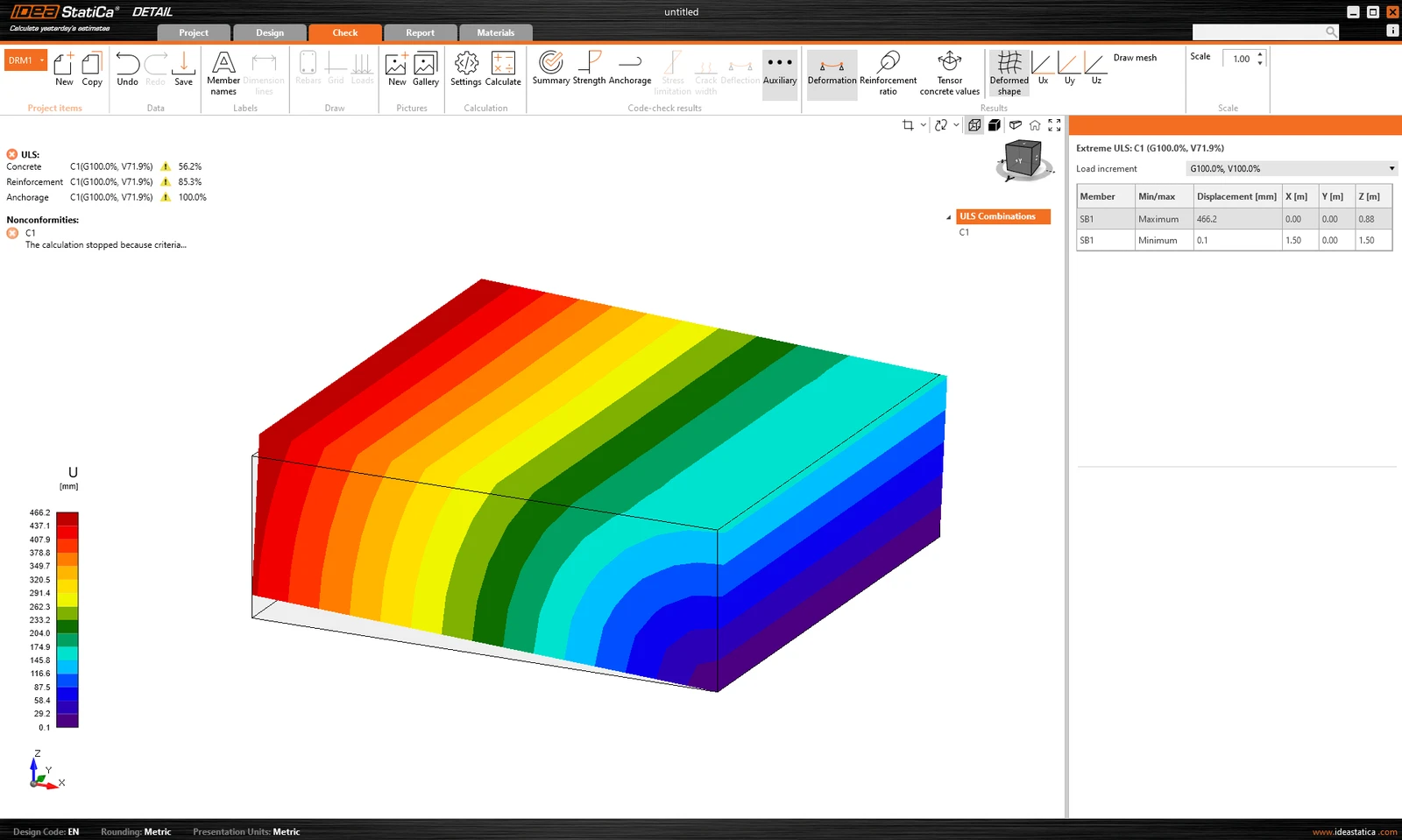
The solver was unable to converge, which means it could not find a stable solution. This can occur due to large deformations, such as overturning, incorrect mesh settings, or other modeling issues. It is recommended to check the auxiliary for a clearer understanding of the model’s behavior.
Examples
Specific examples and a more detailed explanation are provided in following webinars: